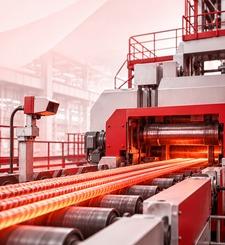


Thinner margins, smarter mills: How margin pressure is pushing India's rebar mills towards the data-run plant
24 Nov 2026
Why conversion cost has become the main margin lever
for long-product steelmakers, and how plants can move from operator-run mills
to data-run operations one process stage at a time?
Rebar is a volume business in which the market sets
the price and raw materials absorb most of the cost. What a producer controls
is conversion: the yield, energy, uptime and manning between the raw material
yard and the dispatch bay. Shopfloor automation turns that conversion
performance from a matter of operator skill into a measurable, repeatable
capability. With margins under pressure across the industry, the question for
most long-product producers is where they stand today and which part of the process
to automate first.
Margins at most
listed steel producers remain well below their pre-boom levels
Steel prices peaked in 2021–22, and margins have not
returned to where they were before. Across ten listed Indian producers, the
combined EBITDA margin fell from 23% in FY19–21 to 16% in FY25–26. Average
annual sales grew 86% between the two periods, while operating profit grew only
31%. Seven of the ten earn lower margins than before the peak, and the
integrated majors saw the steepest falls: 11.5 percentage points at Jindal
Steel and 8.8 at JSW Steel.
Exhibit 1: EBITDA margins of ten listed Indian steel
producers, FY19–21 and FY25–26

The three producers whose margins rose had particular
reasons: Sarda Energy & Minerals earns most of its EBITDA from power, Jai
Balaji Industries started from near-zero margins and Kalyani Steels makes
specialty steel. For producers selling commodity rebar at market prices, the
main lever left is the cost of converting each tonne inside the plant, and that
is the cost shopfloor automation acts on.
Most long-product
mills are still on the first rungs of the digital maturity ladder
Automation in a steel plant builds up in layers. At
the base sit drives, PLCs and operator judgement, where losses are typically
reconciled at month-end rather than managed in real time. Process models come
next, setting furnace, rolling and shear parameters automatically, followed by
a plant-wide manufacturing execution system (MES) that tracks each heat, billet
and bundle, and finally analytics and robotics that predict problems and take
people out of hazardous, repetitive tasks.
Exhibit 2: Digital maturity ladder for a long-product
steel plant

India's large integrated producers are moving up this
ladder quickly. JSW Steel ran more than 150 digital projects in FY24, and Tata
Steel is working towards digital steelmaking by 2030, with remote command
centres already in place. Many of the more than a thousand secondary induction
and electric arc furnace units, which produce around 40% of India's crude steel
and much of its rebar, still run at Level 0–1.
Automation
opportunities span the full process, from the raw material yard to the dispatch
bay
Long products follow one of three routes in India:
blast furnace and basic oxygen furnace in integrated plants, DRI with induction
or electric arc furnaces in secondary plants, or scrap-based electric arc
furnaces. Whatever the route, the process passes through six stages, and each
offers distinct automation opportunities (Exhibit 3).
Raw material handling and preparation:
automated conveyors, belt weighing and moisture checks give a live view of
material use and stock, and reduce losses and stoppages.
Ironmaking:
monitoring temperatures, pressures, gas flows and the use of coke, coal and
oxygen allows deviation alarms and model-based setpoints that lower the fuel
rate.
Steelmaking and secondary metallurgy:
tracking power, oxygen and electrode use, with endpoint prediction, cuts energy
per tonne and tap-to-tap time, and heat-level traceability supports quality
certification.
Continuous casting:
control of casting speed, mould temperature and cooling reduces rejections.
Commercial Metals Company (CMC), a leading US rebar producer, reports that its
Arizona micro-mill, which feeds the rolling mill directly from the caster with
no reheating furnace, uses up to 39% less energy per tonne of bar than its
conventional mills.
Rolling mills and finishing:
automated speed, temperature and dimension control, vision-based defect
detection and automatic bundling and tagging raise throughput and cut scrap.
After Tata Steel modernised the controls of its Jamshedpur bar mill with ABB,
it reported a double-digit rise in productivity and almost 70% fewer
control-system delays.
Material movement and dispatch:
automated weighing, RFID or barcode tracking and dispatch reconciliation link
production orders to finished-goods stock and reduce the identification errors
that dealers notice first.
Exhibit 3: Shopfloor automation opportunities across
the long-product process

The right starting
point depends on where a plant sits on the maturity ladder
Each rung of the ladder decides which process stages
are worth automating next. A plant at Level 0–1 gains most by fitting sensors
to the rolling mill and dispatch, so that yield is measured per billet rather
than per month. At Level 2, a plant-wide MES connecting the melt shop, caster
and dispatch gives heat-level traceability and a clear view of energy cost per
tonne. Analytics and robotics pay back once that data exists. Programmes that
stall usually skip a rung; those that pay back move one level at a time and
express the business case per tonne.
-------------------------------------------------------------------------------------------------------------------------------------