

Peek inside India’s advanced manufacturing landscape
14 Oct 2025
Over the last
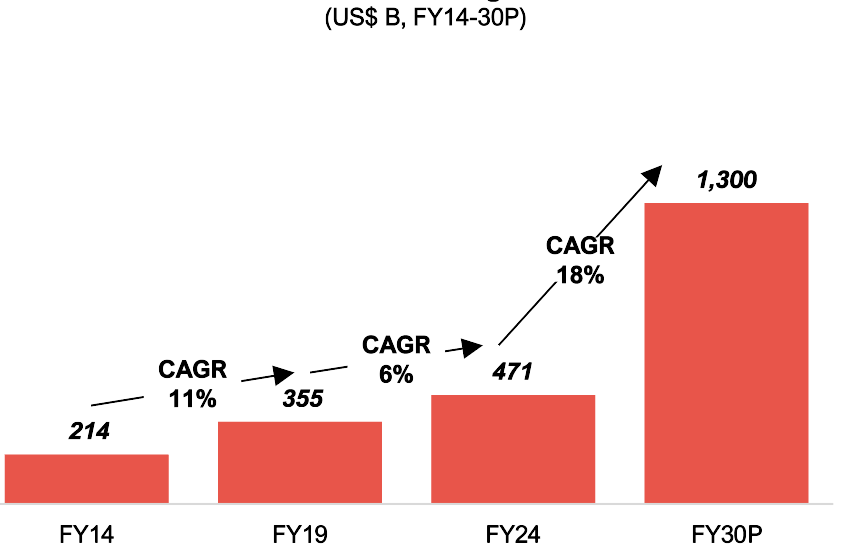
five years, India’s manufacturing output has accelerated meaningfully reaching US$
471B in FY24, growing at 6% CAGR since FY19 and projected to reach US$
1.3T by FY30 (CAGR 18%).
Exhibit
1: Growth in India’s manufacturing GDP
What is fuelling growth in India’s manufacturing landscape?
Policy push and
infrastructure build-out:
a. Multiple policy programs launched by GOI to strategically support deep
tech
- Make in India: launched in 2014
- National Manufacturing Policy:
Aims to increase manufacturing sector contribution to GDP from 17% to 25%
- PLI schemes for advanced
manufacturing: Committed over INR 1.76L Cr across 14 sectors, including
electronics, semiconductors, specialty steel, solar PV, drones, textiles,
automotive, and pharma
b. Infrastructure & Industrial Corridors: Dedicated Freight
Corridors, Defense Industrial Corridors, Integrated Manufacturing Clusters,
Electronics Manufacturing Clusters, and Medical Device Parks to improve
logistics and provide world-class industrial infrastructure
c. Regulatory and Trade Support, Ease of Doing Business Reforms: Digitized
compliance, single-window clearances, and reduced approval timelines
d.
Financial & Trade Support: Capital subsidies, preferential
procurement, export incentives (RoDTEP, MEIS/SEIS), and reduced GST/customs on
high-tech inputs
e. Startup
& MSME funding schemes: SIDBI, Fund of Funds, Credit Linked Capital
Subsidy Scheme (CLCSS) for tech upgrades
f. Global
supply chain rebalancing: The China+1 strategy has led to
a 208% increase in international company registrations in India (2019–2023).
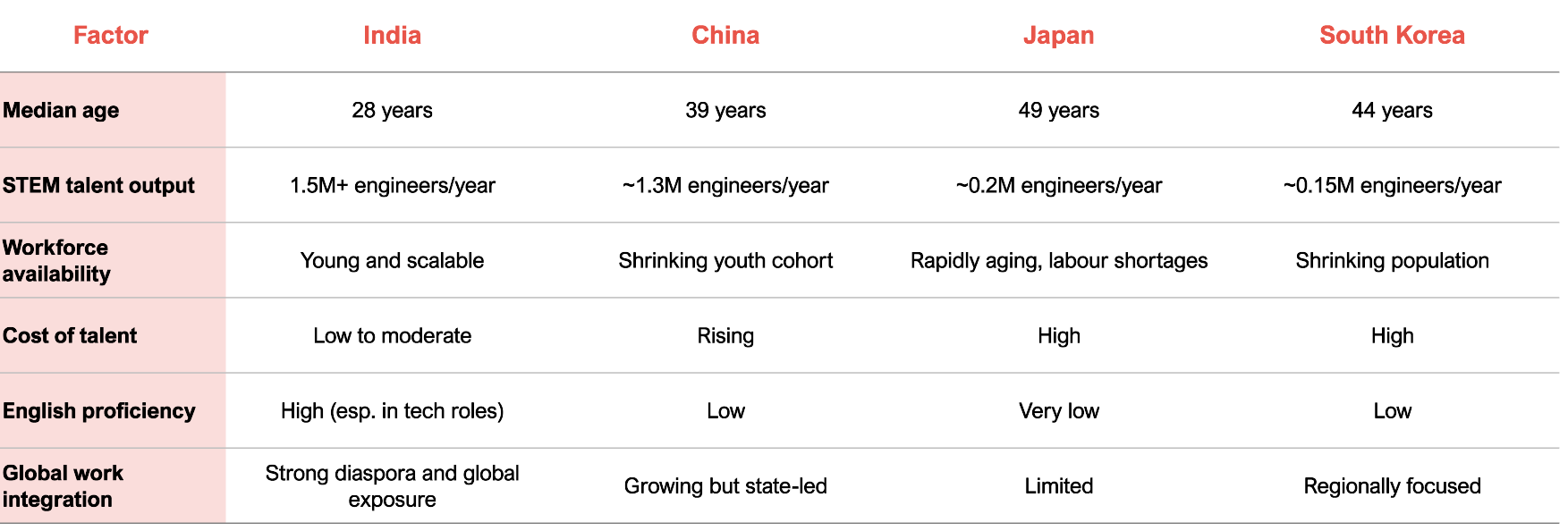
g. Talent and capability advantage: India is set to leverage its demographic dividend with 28 years being the median age. Additionally, a large STEM pool, growing R&D infrastructure, and 1.5M+ engineering graduates have created the human capital base for innovation-led manufacturing steering the country ahead of its global peers in talent (Exhibit 2)
A company qualifies as advanced if it demonstrates innovation across product, process, or technology metrics, meeting at least two parameters in each domain.
Exhibit 3: Key parameters to assess whether a manufacturing technology qualifies as advanced
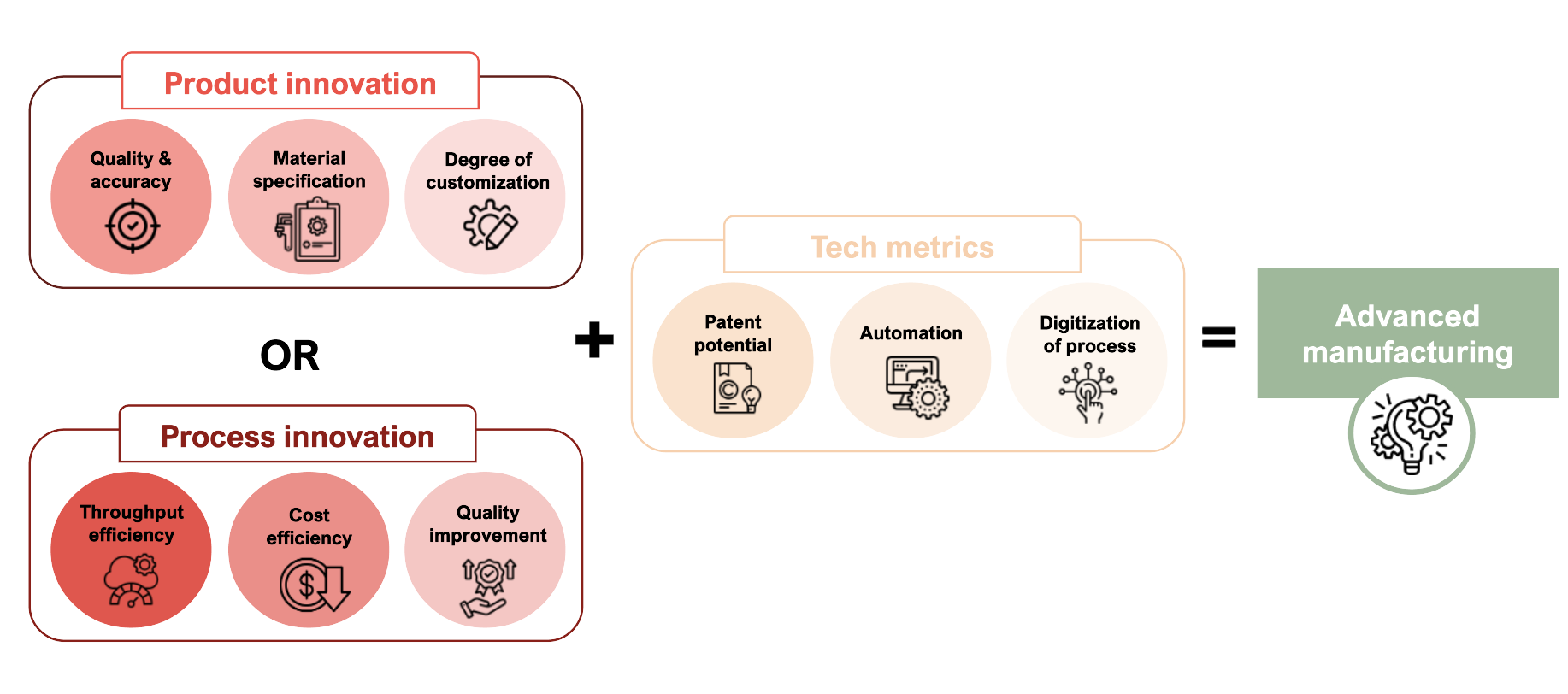
Exhibit 4: Key technological trends emerging out of advanced manufacturing
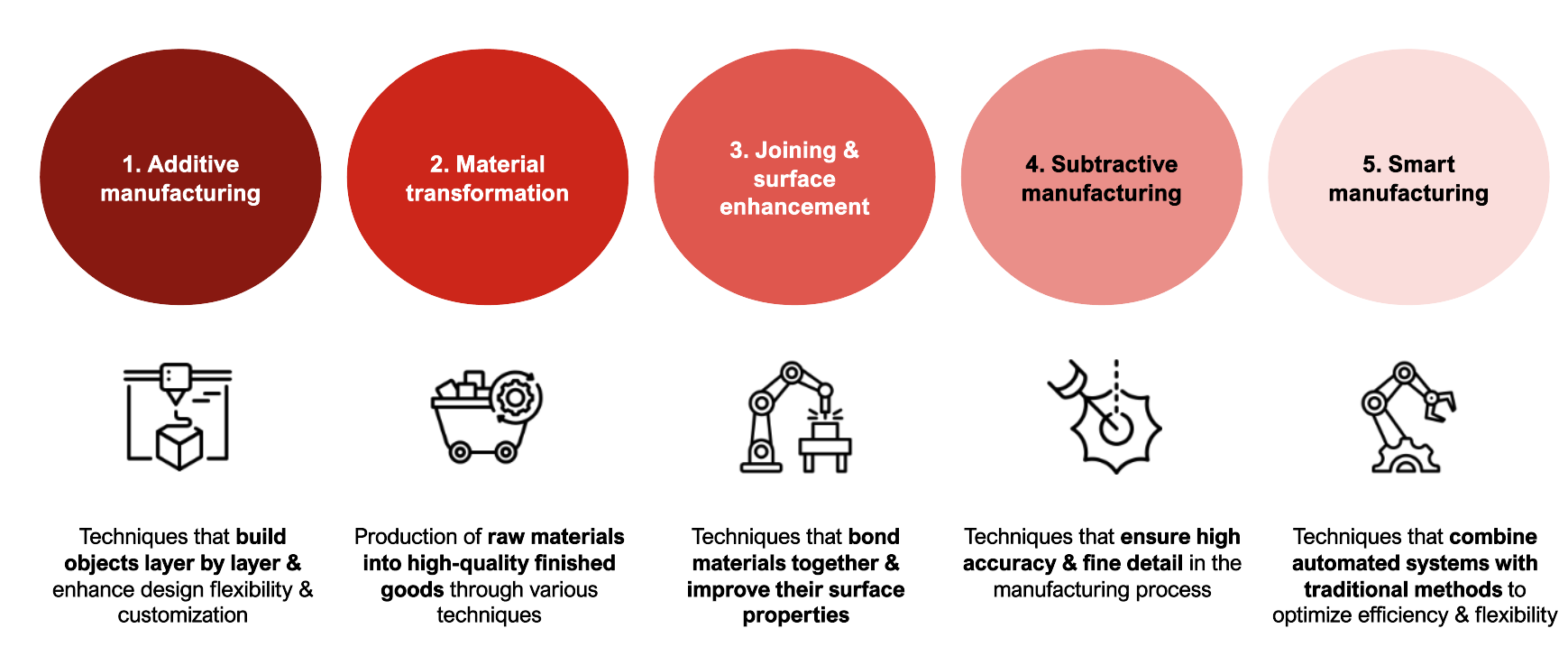
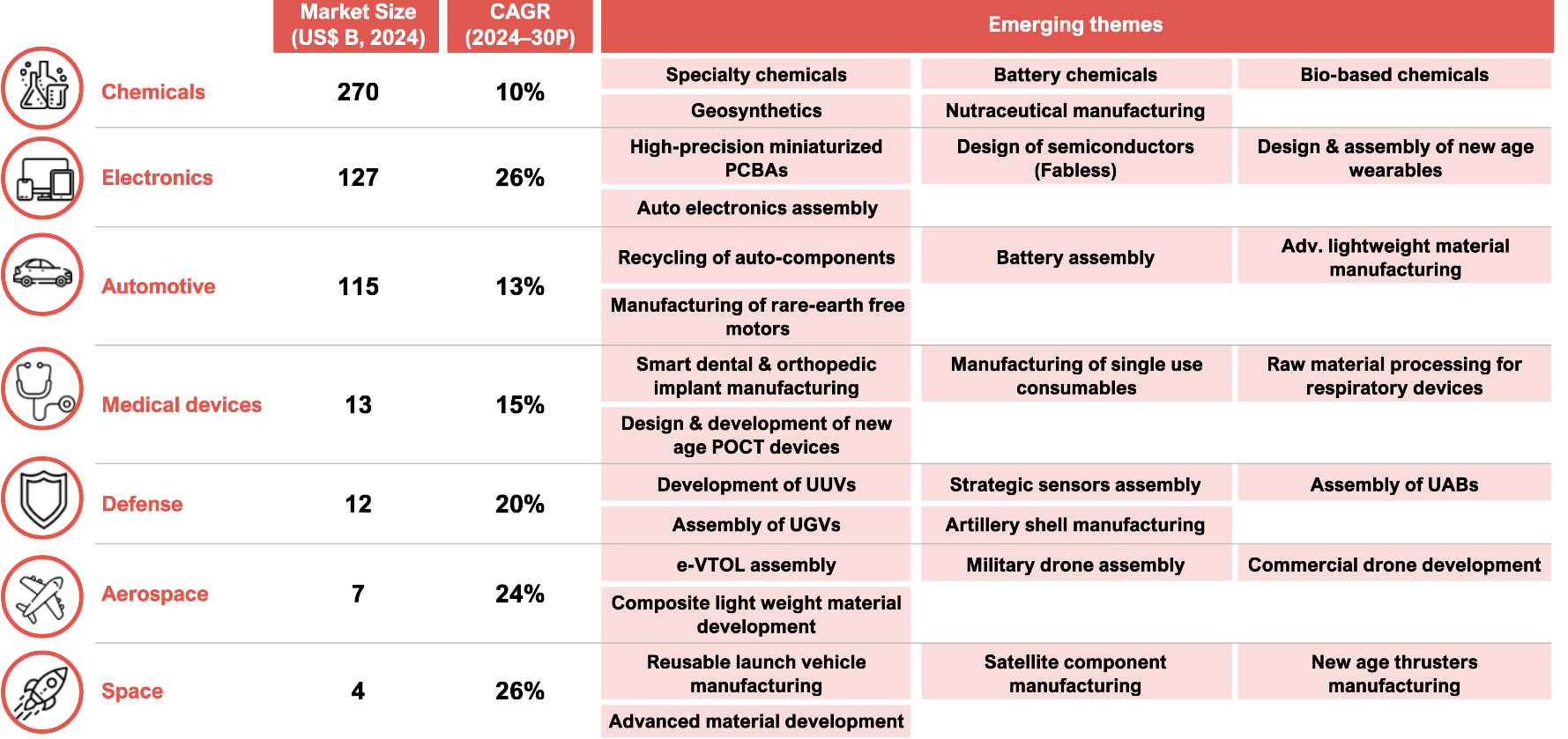
This technological shift is manifesting across a set of seven high-growth verticals: automotive, electronics, chemicals, medical devices, defense, aerospace, and space. Each of these industries is at a unique inflection point, where policy support, private investment, and global demand are converging to redefine India’s industrial mix.
These sectors were shortlisted based on three defining parameters:
1. Market attractiveness: India market size and future market growth focusing on large and fast-growing segments
2. Advanced manufacturing relevance: High applicability of innovation in product design, materials, or process automation; and
3. Investment readiness: Early signals of private participation
At the micro level, Praxis assessed each sector using business fundamentals that determine the viability of new entrant participation: market inflection point (growth stage and saturation), market dynamics (import dependency, competitive intensity), market structure (degree of consolidation), capital intensity (setup and working capital requirements), barriers to entry (brand, distribution, or technology moats), and disruption potential (extent of white spaces for startups and IP creation).
By intersecting these two layers of analysis: sector readiness and startup viability, we identified where innovation, capital, and policy support converge to create high-defensibility opportunities.
Exhibit 5: Opportunity across India’s high growth verticals across advanced manufacturing
How Praxis can help?
At Praxis Global Alliance,
we partner with industrial and manufacturing leaders to capture opportunities
in India’s advanced manufacturing ecosystem. We help clients identify
high-potential sectors, design innovation-led strategies, and enhance operational
readiness through automation, digital transformation, and supply-chain
optimization. Leveraging our expertise across advanced manufacturing, we enable
organizations to move beyond cost advantage toward technology-led
competitiveness and sustainable growth.