


Reimagining insurance through composite licensing
04 Sept 2025
While the life and health combination is often considered the most adjacent and synergistic, the scope of composite licensing is yet to be formally defined. Hence, while illustrative examples may focus on life and health, insurers must be prepared for a broader multi-line possibility, including general insurance, depending on how the regulatory framework evolves.
However, transitioning to a composite model brings operational and strategic complexities. Insurers will need to harmonize distribution approaches, integrate actuarial models built for mono-line portfolios, and align talent, incentives, and performance frameworks across lines of business with differing cultures. Legacy systems and siloed processes further compound the challenge of coordinating health and life operations within a single entity. Realizing the full potential of this shift will demand significant investment in technology, redesign of operating models, and readiness across governance, agility, and strategic clarity to support multi-line coordination and evolving compliance requirements.
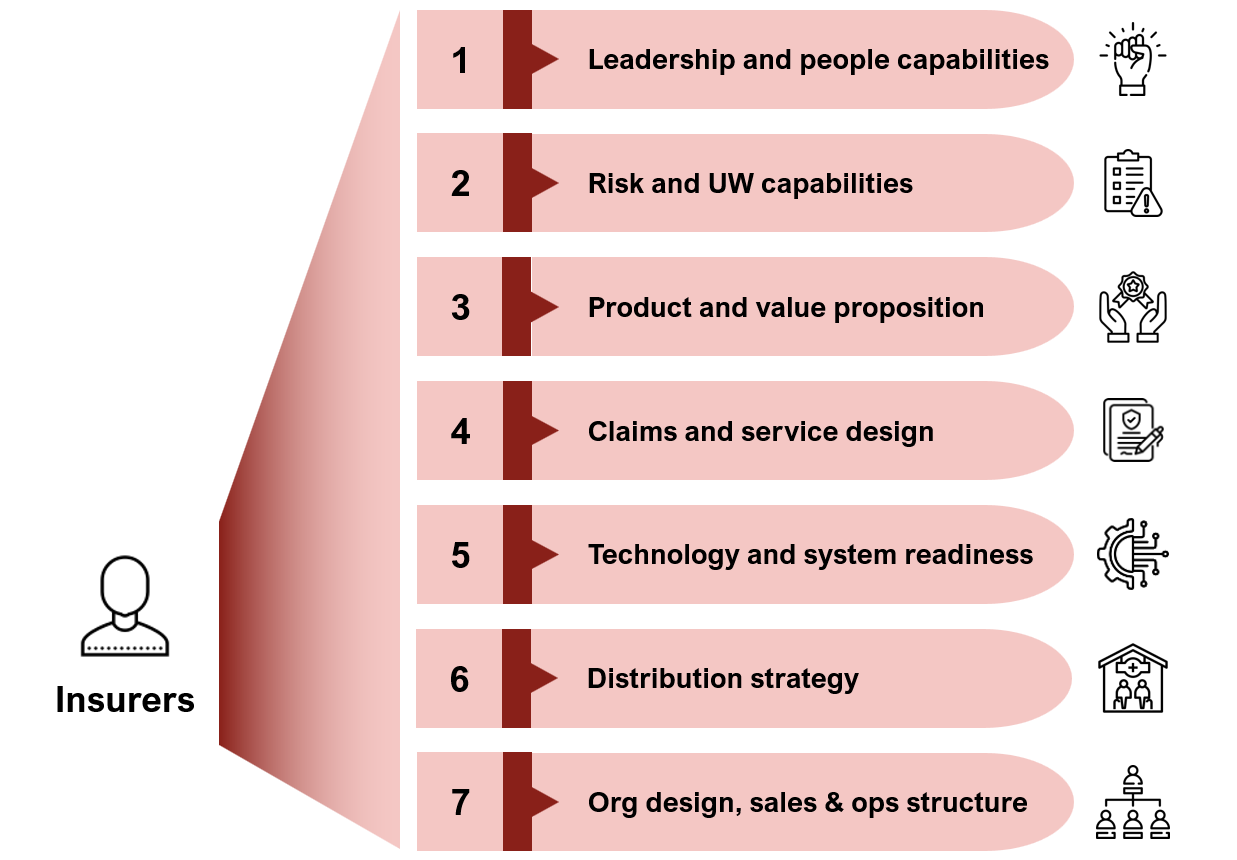
Key considerations for composite licensing implementation for insurers
Drive mindset and
talent shift aligned with multi-line business management
The potential shift towards composite licensing
will require insurers to move beyond product-specific leadership and adopt an
integrated approach. This includes building enterprise-level thinking,
fostering customer-centric decisions, and enabling teams to manage diverse
portfolios (ex: life, health, and general). Clear roles, well-structured teams,
and crossline capability building will be essential. A culture of shared
accountability will help ensure coordinated delivery across the value chain.
2. Risk and underwriting capabilities
Risk and underwriting frameworks will need to adapt to the growing complexity of product differentiation and customer segmentation for the same end customer across product lines
Insurers will need to rethink underwriting models to address distinct risk profiles across lines (ex: mortality, morbidity, and asset risk) while maintaining a unified customer view. Leveraging shared data such as lifestyle, health, behavioural, and asset-related indicators can help assess correlated risks more holistically. Modular frameworks that retain product-specific nuances while enforcing centralized governance will be key to sustainable pricing and portfolio control.
3. Product & Value Proposition
Designing modular offerings that align with customer life stages and drive continuous engagement
Composite licensing opens the door to integrated products that combine protection, prevention, and wellness. Insurers will need to design flexible, modular solutions tailored to evolving needs, supported by value-added services like wellness programs, preventive care, or asset repair. The focus will shift from one-time transactions to lifetime value creation through more personalised and sustained customer engagement.
4. Claims & Service Design
Reconstruct service architecture to manage crossline complexity at scale
Consolidating claims and servicing models across business lines will require insurers to navigate different service expectations and regulatory mandates. Success will depend on designing shared service layers that ensure consistent customer experience while accommodating line-specific nuances. Automation, triaging, and contextual interventions will be critical to delivering scale, efficiency, and personalization.
5. Technology & system readiness
Modernize technology foundations to enable interoperability and composite orchestration
Composite capabilities require systems that support unified customer views, modular product configurations, and seamless compliance. Insurers must evaluate the interoperability of their platforms across business lines and invest in scalable cloud infrastructure, API-first ecosystems, and robust data governance to enable crossline orchestration, agility, and innovation.
6. Distribution strategy
Reconfiguring distribution to drive multi-product engagement and frontline enablement
Shifting to composite models will require distribution to evolve from siloed selling to integrated portfolio engagement. Key areas include retraining agents and POSPs to handle multi-line conversations, restructuring incentives to reflect holistic value delivery, and deploying digital tools to enable contextual and need-based selling. Evaluating distribution partners on their ability to support multi-line strategy will also be critical.
7. Org. design, sales & ops structure
Rebalancing operating spans to drive both efficiency and customer experience
A composite model necessitates a deliberate redesign of organizational structure, especially across Sales and Ops. Balancing centralized efficiency with business-line expertise will be key. This includes redefining reporting lines, governance mechanisms, and performance metrics to support integrated service delivery while maintaining strong customer focus. Spans of control must be thoughtfully restructured to avoid duplication and enable agility without compromising quality or compliance.
Composite licensing, while still under consideration, represents more than a regulatory development. It signals a potential structural shift in how insurers operate, create value, and engage with customers. The seven areas outlined above from leadership and underwriting to technology, service design, and distribution offer a foundation for early assessment. Insurers that begin evaluating readiness across these dimensions will be better placed to respond with clarity and speed if the transition takes shape.
How can Praxis help?
Praxis can support insurers in navigating the composite licensing transition through portfolio strategy, operating model redesign, and execution planning. We bring deep expertise in integrating multi-line businesses, aligning distribution and talent models, and enabling tech-led transformation.