

The Bio Turn: How India’s Agrochemical Industry is Moving Toward Sustainable Growth
14 Oct 2025
This transition goes beyond replacing inputs. It represents a gradual shift toward green chemistry, where productivity and environmental responsibility coexist. Biostimulants are becoming a practical link between sustainability and farm profitability, aligning India’s agricultural systems with global goals on climate resilience and food security.
Indian agrochemicals at the crossroads: Traditional inputs meet biological innovation
In agriculture, sustainable chemical inputs are gaining traction with biologicals (comprising biostimulants, biofertilizers, and biopesticides) emerging as a fast-growing category, bridging the gap between traditional agrochemicals and natural solutions to support sustainable farming. Among these, biostimulants have gained the strongest traction due to their proven ability to enhance crop productivity while improving soil health, making them the leading edge of India's biological growth story.
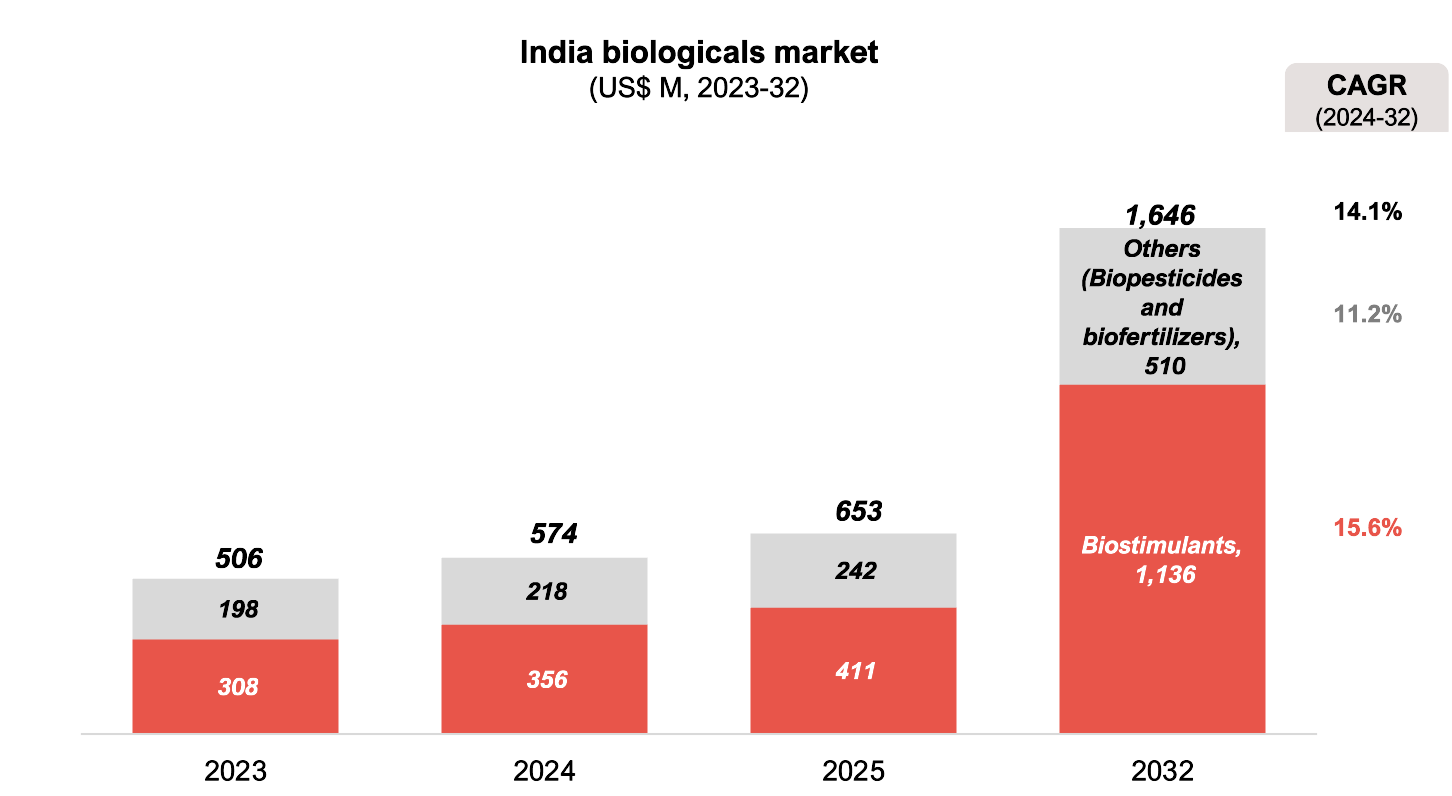
Biostimulant segment is expanding steadily. It is projected to grow from US$400M in 2025 to US$1,100M by 2032, at a CAGR of 16%
Among product types, seaweed-based extracts account for about 39% of the biostimulants market, followed by Humic and amino acid–based biostimulants.
Exhibit 1: Fast growing biostimulants segment with India’s Biologicals market
This expansion is being driven by four key forces.
1. Policy and Regulatory Push
- The 2023 Biostimulant Guidelines under the Fertilizer
Control Order (FCO) provided long-awaited clarity on product registration,
label claims, and quality control
- With 146 products approved and several more under review, the segment has transitioned from informal activity to a regulated category
- About 60% of Indian soils are low in organic carbon
- Fertilizer overuse has reached diminishing returns, while
biostimulants enhance nutrient-use efficiency, improve soil biology, and build
crop stress tolerance
- The 70% increase in urea prices during the 2022 global fertilizer crisis reinforced the need for lower-input, higher-efficiency solutions
- Global buyers increasingly require residue-free produce, especially in grapes, tea, and spices.
- Exporters use biostimulants to meet residue
norms in European
and North American markets
These
trends are not just policy or market abstractions—they shape real-world
decisions at the farm level. Farmers are increasingly looking for solutions
that do
more with less, improve soil health, and meet sustainability
and export standards. This is where biostimulants complement traditional
fertilizers, creating a practical path for India’s green transition.
Biostimulants
and bulk fertilizers: Partners in growth, not replacements
From farm level impact
to industry action: How indian firms are accelerating the Bio transition
The
complementary benefits of bulk fertilizers and biostimulants are not just
theoretical—they are shaping real-world strategies for agrochemical
companies and startups in India. Firms are investing in bio-based solutions
to meet farmer demand, sustainability goals, and export requirements,
translating the promise of biostimulants into scalable offerings.
With
clear policy direction and rising farmer awareness, Indian agrochemical players
are rapidly expanding their bio-based portfolios:
- UPL is scaling its Natural Plant Protection (NPP) division globally
- Coromandel Internationa is investing in microbial and seaweed-based inputs under its Bio Products Division.
- Sumitomo Chemical India is integrating biologicals into its broader agri-input portfolio
- Tradecorp has launched Biimore, a next-generation biostimulant targeting fruit, legume, and horticultural segments
- Sea6
Energy
(funded by BASF and Tata Capital) pioneers seaweed-derived biostimulants.
- BioPrime AgriSolutions, backed by Omnivore, focuses on microbiome-based crop enhancers
- Absolute’s Inera and Varaha are leveraging data and carbon analytics to scale sustainable agri-input adoption
Despite strong policy and market tailwinds, several challenges
continue to constrain large-scale adoption and commercialisation:
- Stringent testing, documentation, and bio-efficacy trial requirements increase costs
- Small and mid-sized firms struggle to meet these obligations,
leading to market exits
- Majority of humic acids and seaweed extracts are import dependent
- Weak domestic testing and certification systems allow substandard imports to slip through, resulting in inconsistent product quality that erodes farmer confidence and disrupts market pricing
- Awareness of product efficacy and correct dosage remains low, especially in Tier-2 & Tier-3 markets
- Farmers often prefer traditional fertilizers due to immediate visible results & government subsidies
- Weak supply-chain linkages limit product availability in key agri-belts
- Storage and transport challenges reduce shelf life and product effectiveness
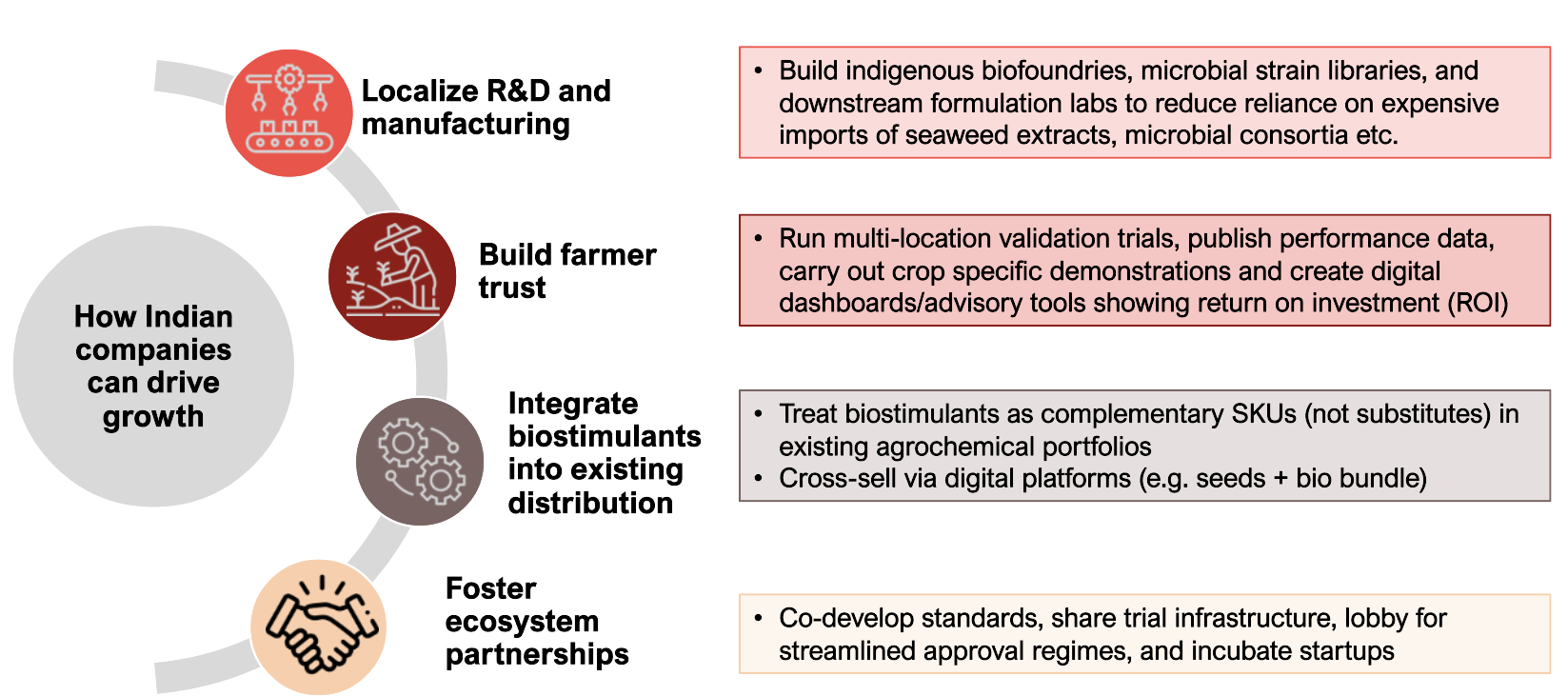
Exhibit 3: What Indian firms can do to drive biostimulants growth
Conclusion
India’s green chemistry transition is no longer
a distant aspiration; it’s unfolding in real time. Biostimulants have emerged
as the vanguard of this shift, offering a pathway to sustainable productivity,
resilient soils, and higher farmer profitability. As innovation converges with
regulation and market pull, the winners will be those who move beyond
compliance to actively design for impact, investing in research, partnerships,
and new business models that make biological inputs both scalable and profitable.
How Praxis can help ?
At Praxis, we help agrochemical and agri-input
companies tap into the fast-growing biostimulants market. Our focus is on designing
product–market entry strategies, accelerate sales, and build farmer-focused
go-to-market models for faster adoption. With deep expertise in agribusiness
and chemicals space, we bring in proven frameworks and benchmarks to enable portfolio
synergy with existing agri-input lines, support diversification into
new segments, strengthen regulatory and market readiness and turn the biostimulant
opportunity into real growth and long-term advantage for our client.